Off-plan condo risks in Thailand — what to verify
Buying off-plan means paying for a unit before it exists. That shifts real risk onto the buyer. Here is what to verify and how to protect the money you put down.
Reviewed by TransferDueLast reviewed 11 June 2026
Confirm permits are in place before any payment
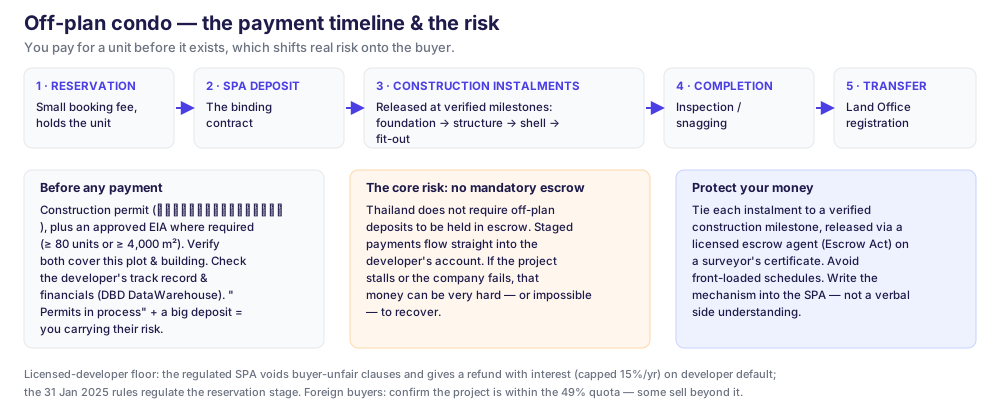
Two approvals should be in place before you hand over any money. The construction permit (ใบอนุญาตก่อสร้าง) from the local administrative authority confirms the building is licensed to proceed. An approved Environmental Impact Assessment (EIA) is separately required for a residential or condominium project with 80 or more dwelling units, or a total usable area of 4,000 sq m or more, and is reviewed by the Office of Natural Resources and Environmental Policy and Planning (ONEP). Where an EIA is required it must be approved before the construction permit is issued — so a valid permit for a qualifying building implies the EIA has already cleared.
Ask the developer for certified copies of both documents and verify they cover the actual building and plot. A developer who says approvals are 'under review' or 'in process' while requesting a significant deposit is asking you to carry regulatory risk that belongs to them.
Verify the developer's track record and financial standing
Research the developer's history: how many projects have they completed in Thailand, did those projects complete on time, and are the finished buildings well-maintained. The Department of Business Development publishes companies' filed financial statements, directors, and registered capital through its DataWarehouse service — the strongest public signal of a developer's financial standing. Court judgments and insolvency proceedings are harder to search directly and may need a Thai lawyer or a corporate-records service to check.
A developer with a thin track record, no completed projects in Thailand, or a pattern of material delays on prior developments is a higher-risk counterparty for a long-duration off-plan commitment.
Understand the no-mandatory-escrow risk
Thailand does not require developers to hold off-plan buyer deposits in escrow. Staged payments typically flow directly into the developer's operating account — which means if the project stalls, the company fails, or the building is never completed, those funds can be very difficult or impossible to recover.
This is a significant structural risk in an off-plan purchase. For a licensed developer the regulated standard contract softens it (see below), but the absence of mandatory escrow on your staged payments remains the baseline condition; any protection you can negotiate is better than none, so factor it into your risk assessment before committing.
Know the consumer-protection floor for a developer sale
A licensed developer selling units to the public cannot write the contract entirely in its own favour. The sale and purchase agreement must follow a Ministry of Interior standard form prescribed under the Condominium Act, and any clause that departs from it against the buyer's interest is void by law. If the developer fails to complete or transfer, the standard form entitles the buyer to a refund with interest — at the contract's own default-interest rate, which the form caps at 15% a year — and it also caps the penalty a defaulting buyer can be charged and limits how the developer allocates transfer charges.
Since 31 January 2025 the reservation stage is regulated too: a developer's condo reservation contract is a 'contract-controlled' business under Office of the Consumer Protection Board rules. The developer cannot keep the reservation fee unless you are the one who fails to proceed, must use a Thai-language contract, and must refund the fee within set time limits if it breaches or, in many cases, if your financing is refused. These protections are a floor the developer cannot draft below — but they apply to licensed developer sales, not to a private resale, and they do not substitute for escrow or milestone protection on the staged payments themselves.
Review the deposit and instalment terms
Read the payment schedule carefully: understand what percentage is due on reservation, on SPA signing, at each construction milestone, and at transfer. Confirm whether the reservation deposit and the SPA deposit are refundable and under what conditions.
Compare instalment amounts against the developer's stated construction timeline. Payments weighted heavily toward early stages — before significant construction is visible — concentrate more risk on the buyer and less pressure on the developer to perform.
Negotiate milestone-based payment release
Where possible, negotiate for each instalment to be released against a verified construction milestone rather than a calendar date. Milestones might include: completion of the foundation, the structural frame, the building shell, and fit-out. Independent verification by a licensed surveyor at each milestone adds meaningful protection.
Route staged payments through a licensed escrow agent — under the Escrow Act this is a licensed institution, typically a bank or finance company — that releases each tranche only on receipt of a milestone certificate. A Thai law firm's client account is a weaker, purely contractual alternative, not statutory escrow. Write the chosen mechanism into the SPA as a condition of payment release, not as a verbal side understanding.
Identify red flags before you sign
Large deposit requests before permits are confirmed is the clearest red flag. Pressure to sign quickly, or to pay before the SPA is ready, gives you less time to check what you are committing to.
An SPA that gives the developer unlimited delay with no termination right for the buyer is a major contractual risk. An SPA silent on what happens if the project is abandoned, or that returns only the principal deposit without interest on a developer-default termination, leaves the buyer in a weak position.
Also watch for suggestions to register the purchase in a Thai company's name to sidestep the foreign-ownership quota. Using a company with Thai nominee shareholders to hold property for a foreigner is an illegal nominee arrangement under the Foreign Business Act and Land Code — now the subject of active 2025–2026 enforcement — and carries criminal as well as tax and exit risk; it does not safely bypass the 49% cap.
Check the foreign-ownership quota if you are a foreigner
Foreign buyers can own up to 49% of the total floor area of all units in a condominium project under the Condominium Act. Off-plan projects sometimes sell beyond that cap speculatively, leaving later foreign buyers without quota when transfer time arrives.
Ask the developer for the current foreign-to-Thai ownership ratio as a percentage of total floor area, confirm it in writing, and ensure the SPA includes a clause specifying what refund you receive if your unit cannot be registered as foreign-owned at transfer.
Frequently asked questions
- Is my deposit on an off-plan Thai condo protected?
- Not by default. Thailand does not mandate escrow for off-plan sales, so deposits typically flow directly to the developer. You can negotiate protection — a licensed escrow agent, a lawyer's client account, or milestone-based release — and have it written into the contract.
- What permits should an off-plan project hold before I pay?
- At minimum, the construction permit (ใบอนุญาตก่อสร้าง) from the local authority, and an approved EIA where the project type or scale requires one. Ask for certified copies and verify the documents cover the actual plot and building, not just a related entity.
- What is the biggest risk of buying off-plan in Thailand?
- The combination of no mandatory escrow with developer default or delay. Money paid directly to a developer that then stalls or becomes insolvent can be very difficult to recover. Deposit protection and due diligence on the developer are the primary mitigations.
- How do I check whether a developer's EIA has been approved?
- Approved EIAs for qualifying projects are registered with the Office of Natural Resources and Environmental Policy and Planning (ONEP). You can request the EIA approval document from the developer directly; a legitimate developer will provide a certified copy. If the developer cannot or will not produce one, treat that as a red flag.
- What is a milestone-based release clause and why does it matter?
- A milestone-based release clause ties each instalment payment to a verified stage of construction — foundation, structural frame, building shell — rather than a calendar date. It means the developer must actually build before receiving each tranche, which protects the buyer if construction stalls between scheduled payments.
- Can I transfer my off-plan contract to another buyer?
- Only if the SPA permits it. Some developer contracts prohibit assignment or require developer consent and a transfer fee. If you think you may need to sell before completion, confirm assignment rights in the contract before signing — they are not guaranteed by law.