Reservation agreement vs sale and purchase agreement (SPA)
A Thai condo purchase usually moves through two contracts: a short reservation agreement, then the full SPA. They commit you to different things — here is how they differ and what to read in each.
Reviewed by TransferDueLast reviewed 11 June 2026
The reservation agreement (ใบจอง)
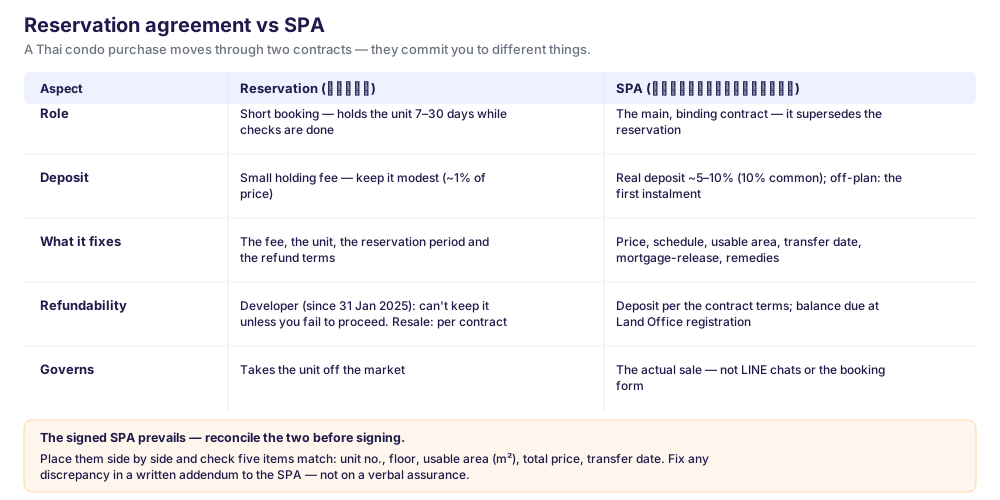
A reservation agreement (ใบจอง, bai jong) is a short booking contract, typically one to four pages, signed with a small reservation deposit. It takes the unit off the market for a set period — usually 7 to 30 days — while the full contract is prepared and your checks are done.
Its core terms are the fee amount, what unit is reserved, how long the reservation lasts, and whether the fee is refundable if you do not proceed. For a licensed developer this is now regulated: since 31 January 2025 a developer's condo reservation contract is a 'contract-controlled' business, so the developer cannot keep the fee unless you are the one who fails to proceed, and must refund it within set time limits if it breaches or, often, if your financing is refused. In a private resale, refundability is whatever the contract says — confirm the clause in writing before paying anything.
The sale and purchase agreement (SPA)
The SPA (สัญญาจะซื้อจะขาย, sanya ja sue ja khai) is the main, binding contract. It sets the full purchase price, the payment schedule (deposit, any staged instalments, and the balance due at Land Office registration), the unit specification including usable area in square metres, the transfer or completion date, and both parties' obligations and remedies.
The SPA supersedes the reservation agreement and governs the actual sale. Once signed, the SPA is what you are bound by — not verbal discussions, LINE messages, or the earlier booking form.
Deposit mechanics at each stage
At reservation you pay a small holding fee — commonly a flat sum in the tens of thousands of baht; because it is typically unsecured, keep it modest (lawyers often suggest no more than about 1% of the price). At SPA signing the contract requires the real deposit — typically 5–10% of the purchase price for a resale unit, with 10% the most common figure — or, for an off-plan project, the first instalment of the developer's payment schedule. The remaining balance is due at transfer registration at the Land Office.
Confirm in the SPA whether the reservation fee is credited against the SPA deposit or treated as a separate, non-refundable payment, and whether the SPA deposit is refundable if the deal does not complete through no fault of the buyer.
Clause-by-clause SPA read
Match the unit number, floor, and area against the title deed (chanote) or the developer's floor plan before signing. Verify the total price and payment schedule match what was negotiated. Look for a clause requiring any mortgage on the unit to be discharged before or at the transfer date — without it, a mortgaged unit cannot be cleanly registered in the buyer's name.
Check who bears each government charge at transfer: the 2% transfer fee, specific business tax or stamp duty, and withholding tax. In a resale the law sets default liability but the SPA can reassign any charge. In a licensed developer's sale the regulated standard contract caps this — the developer bears income tax, business tax, and stamp duty and can pass at most half of the 2% transfer fee to the buyer, so a clause shifting everything to you is unenforceable. Also look for a foreign-ownership quota clause, a developer-delay clause for off-plan, and the remedies each side has on default.
Mortgage release and foreign-quota failure
If the unit carries a mortgage, the SPA must require the seller to discharge it before or at the transfer date. The Land Office registers mortgages against the title deed — a buyer who takes title on a mortgaged unit inherits that encumbrance. A clause absent here is a material gap.
A foreign buyer should also confirm the SPA addresses what happens if the building's foreign-ownership quota is already exhausted at the time of transfer. Without a remedy clause, the buyer has no clear contractual path to terminate and recover funds.
Remedies on default for both sides
If the seller fails to transfer, the SPA should entitle the buyer to terminate and recover the full deposit plus any agreed interest or damages. If the buyer fails to complete, the seller typically retains the deposit. Both remedies should be stated explicitly — a contract silent on either side's default leaves one party without a clear path.
For off-plan, look for a clause specifying a grace period beyond the target completion date, the notice required to trigger it, and the refund the buyer receives on termination. A contract granting the developer unlimited delay with no buyer-side remedy is a significant risk.
Protecting a deposit — no default escrow in Thailand
Thailand has no statutory requirement for developers or sellers to hold buyer deposits in escrow. Deposits paid directly to a seller or developer can be hard to recover if the deal collapses or the developer becomes insolvent.
One structural mitigation is to route the deposit through a licensed escrow agent — under the Escrow Act, a licensed institution such as a bank or finance company — that releases funds only against defined conditions agreed in writing. A Thai law firm's client account is a weaker, purely contractual alternative, not statutory escrow. For off-plan, tie staged instalments to verified construction milestones — confirmed by an independent surveyor — rather than calendar dates, and write that mechanism into the contract.
Red flags in both contracts
A reservation agreement with no refund clause, or a non-refundable fee disproportionate to the price, is worth negotiating. An SPA silent on mortgage release where the unit is mortgaged is a serious gap. An SPA that assigns all government charges to the buyer rather than following statutory defaults should prompt renegotiation of the price.
Any discrepancy between the reservation agreement and the SPA — different unit number, different area, different price — should be resolved in a written addendum to the SPA before signing. Do not rely on the seller's verbal assurance that the booking form was an error.
How to check both contracts agree
Place the reservation agreement and the SPA side by side and compare five items: unit number, floor, usable area in square metres, total purchase price, and the transfer or completion date. Any difference in these items needs a written correction in the SPA before you sign.
Then confirm the SPA contains: a mortgage-release obligation on the seller, an allocation of every government charge, a foreign-quota remedy for foreign buyers, a developer-delay remedy for off-plan, and explicit remedies on default for both buyer and seller. Clauses absent on any of these points should be added as a signed addendum — signed contracts govern, and discrepancies left unresolved become disputes.
Frequently asked questions
- Do I sign the reservation agreement or the SPA first?
- The reservation agreement first — a short booking with a small deposit that holds the unit. The full sale and purchase agreement (SPA), with the price, payment schedule, and transfer terms, follows and is the binding contract.
- Is the reservation fee refundable?
- For a licensed developer, no longer entirely a matter of contract: since 31 January 2025 a developer cannot keep your reservation fee unless you are the one who fails to proceed, and must refund it within set time limits if the developer breaches or, often, if your financing is refused. In a private resale it depends on what the reservation agreement says — some fees are non-refundable, some credit toward the SPA deposit. Confirm the refund terms in writing before paying.
- What if the reservation agreement and SPA say different things?
- Resolve the discrepancy before signing the SPA. The signed SPA governs the sale, so any difference in unit, area, price, or deposit must be corrected in the SPA itself, not left to the earlier booking form.
- What happens if the seller's unit has a mortgage?
- The SPA should require the seller to discharge the mortgage before or at the transfer date. Without that clause, the title deed carries the mortgage at registration and the buyer inherits the encumbrance. If the clause is absent, request it as a written addendum before signing.
- What if the building's foreign-ownership quota is already full at transfer?
- Without a clause in the SPA addressing quota failure, a foreign buyer has no clear contractual remedy. The SPA should specify what happens — typically a right to terminate and recover the full deposit — if the foreign quota cannot be met at the transfer date.
- Can a developer keep my deposit if the project is delayed?
- Only if the SPA permits it. A well-drafted SPA for an off-plan purchase gives the buyer a right to terminate and recover the deposit if the developer misses the completion date by more than a defined grace period. If that clause is absent, recovery may require legal action.
- Should I have a Thai lawyer review the SPA before signing?
- Having a Thai-qualified lawyer review both the reservation agreement and the SPA before signing is advisable, particularly for a first purchase or an off-plan transaction. The SPA cannot easily be renegotiated once signed, and missing clauses are the most common source of disputes.