Condo transfer fees and taxes in Thailand — who pays what
Transferring a Thai condo triggers several government charges at the Land Office. Here is what each one is, who is legally liable, and why the contract decides who actually pays.
Reviewed by TransferDueLast reviewed 11 June 2026
Know the charges that arise at transfer
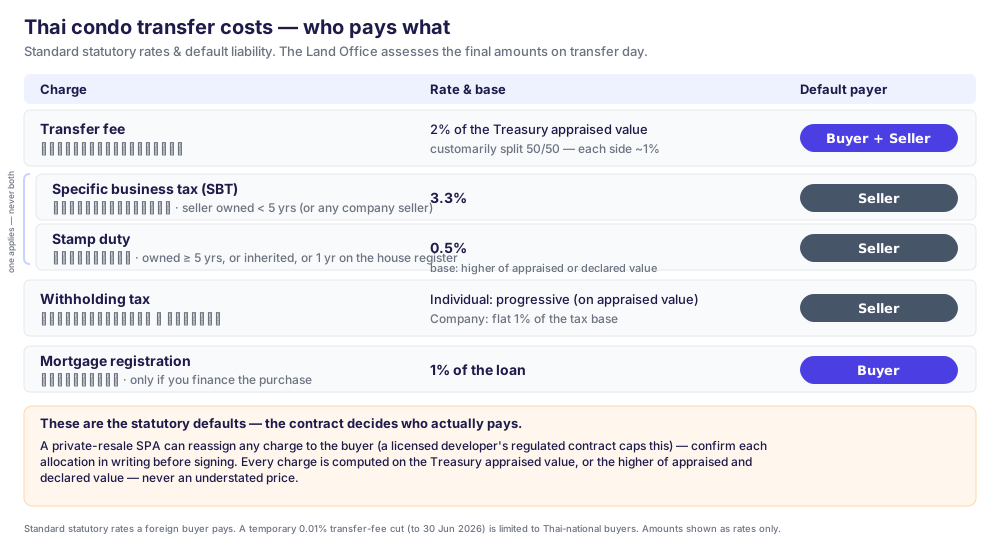
Four charges can arise when a condo unit is registered at the Land Office: a transfer fee, either specific business tax (SBT) or stamp duty (but not both), and withholding tax. They do not all share one base: the 2% transfer fee is charged on the Treasury Department's appraised value (ราคาประเมินทุนทรัพย์); SBT and stamp duty on the higher of the appraised value or the declared price; and an individual seller's withholding tax on the appraised value. None is computed on a price the parties agree to understate. A separate mortgage-registration fee applies only if the buyer finances the purchase with a registered mortgage.
The rates below are the standard statutory figures. Temporary government reductions come and go: a cut of the transfer and mortgage-registration fees to 0.01% runs to 30 June 2027, but it is limited to Thai-national buyers of a residence priced 7,000,000 THB or under, so foreign buyers do not qualify and pay the full rates below. Every amount is an estimate until the Land Office assesses it on the day — treat these as a budgeting guide, not a guarantee.
Calculate the 2% transfer fee
The transfer fee is 2% of the Treasury Department's appraised value (ราคาประเมินทุนทรัพย์) — not the declared price, and not the higher of the two. It is the one charge customarily split 50/50 between buyer and seller — meaning each pays 1% in practice — though the split is a matter of contract and the SPA can allocate it differently or assign it entirely to one side.
On a unit where the appraised value is 4,000,000 THB and the declared price is 5,000,000 THB, the transfer fee is charged on the 4,000,000 THB appraised value: 80,000 THB total, customarily 40,000 THB per side.
Apply the SBT vs stamp duty rule
If the seller has owned the unit for less than five years from acquisition to transfer, specific business tax (SBT) of 3.3% applies. If the seller has owned it for five years or more, SBT does not apply and stamp duty of 0.5% is charged instead. The two are mutually exclusive — only one applies for any given transaction. Two carve-outs change the rule: a company (juristic-person) seller does not get the five-year exemption — SBT applies to a corporate seller regardless of holding period — and a unit the seller acquired by inheritance is exempt from SBT no matter how recently it was inherited, leaving only the 0.5% stamp duty.
One exemption matters in practice: a seller whose name has been on the unit's house register (ทะเบียนบ้าน, tabien baan) for at least one year is exempt from SBT even within the five-year window — 0.5% stamp duty applies instead. That swaps a 3.3% charge for a 0.5% one, so if the seller claims the exemption, ask for evidence of the registration date before budgeting either figure.
Both are computed on the higher of the appraised value or the declared price. SBT and stamp duty are statutory seller costs. SBT is a normal, lawful charge tied to a short holding period — its presence does not indicate anything is wrong with the transaction.
Estimate the withholding tax
The seller owes withholding tax. For a company seller, it is a flat 1% of the tax base (the higher of appraised value or declared price). For an individual seller, it is progressive and computed on the appraised value alone: the appraised value, less a statutory expense allowance that ranges from 50% to 92% depending on how long the seller has owned the unit, is divided by the number of years owned to give a notional annual income, that figure is taxed on the land-office withholding scale (which taxes the first bracket at 5% from the first baht — the ordinary 150,000 THB exempt band does not apply here), and the result is multiplied by years owned. The years divisor is capped at ten; a seller who acquired the unit by inheritance or gift uses a flat 50% expense allowance regardless of holding period; and for a non-commercial sale the total withholding is capped at 20% of the sale price. Individual withholding is therefore an estimate until the Land Office computes it on the day.
Withholding tax is the seller's statutory liability, but the SPA can assign it to the buyer. Confirm the allocation in writing before signing.
Work a budgeting example
Illustrative example — actual amounts are assessed by the Land Office on transfer day. Assumptions: resale price 5,000,000 THB, appraised value 4,500,000 THB, individual seller who has owned the unit for three years and is not registered on its house register. Transfer fee: 4,500,000 (appraised value) × 2% = 90,000 THB (split 50/50 by convention: 45,000 THB each). SBT: 5,000,000 (the higher of appraised value or price) × 3.3% = 165,000 THB (seller; owned under five years). Individual withholding: computed progressively by the Land Office — typically several tens of thousands of baht for a transaction in this range.
Total government charges in this example: approximately 255,000 THB plus individual withholding. If the SPA assigns SBT to the buyer, add 165,000 THB to the buyer's outlay. These are estimates only; the Land Office assessment on transfer day governs.
Confirm who pays in the SPA
Statutory defaults: the transfer fee is shared (often 50/50), SBT and stamp duty are the seller's, and withholding tax is the seller's. In a private resale, Thai law lets the SPA reassign any of these to the buyer, so allocation is freely negotiable. In a sale by a licensed developer the regulated standard contract limits this — the developer must bear income tax, SBT, and stamp duty and can pass at most half of the 2% transfer fee to the buyer, so a clause dumping every charge on the buyer is unenforceable.
Because who pays is set by contract rather than immutably by statute, read the SPA's tax-allocation clause before signing. If the clause is silent on a charge, the statutory default applies — but confirm with the Land Office or a Thai lawyer, as an ambiguous clause can create a dispute at transfer day.
Spot red flags at the Land Office
Pressure to understate the declared price to reduce charges is illegal. The Land Office cross-checks the declared price against its own appraised value and will use the higher figure regardless of what the contract states.
If a seller insists on a declared price far below the agreed sale price, or if a contract presents two prices — one 'official' and one 'unofficial' — treat this as a serious red flag. It can expose both buyer and seller to penalties, affects the capital-gains base for future resale, and may constitute tax fraud.
Also identify whether the SPA assigns SBT, stamp duty, and withholding tax to the buyer on top of the purchase price, effectively raising the buyer's true cost by several percent. In a resale this is negotiable; in a licensed developer's regulated contract the share that can be shifted to you is capped. Budget for the full charge allocation before committing.
Frequently asked questions
- What taxes are due when buying a condo in Thailand?
- At transfer: a 2% transfer fee, then either 3.3% specific business tax (seller owned under five years — and any company seller, regardless of holding period) or 0.5% stamp duty (five years or more, or a unit the seller inherited), plus the seller's withholding tax. The transfer fee and an individual seller's withholding tax are charged on the Treasury Department's appraised value; SBT and stamp duty on the higher of the appraised value or the declared sale price.
- Does the buyer or seller pay?
- By law the transfer fee is shared and SBT, stamp duty, and withholding tax are the seller's. In practice the SPA can reassign any of them to the buyer — so what you actually pay depends on the contract. Confirm each charge's allocation in writing before signing.
- Why does a sale within five years cost more?
- A unit sold less than five years after the seller acquired it attracts 3.3% specific business tax. At five years or more, SBT falls away and only 0.5% stamp duty applies. One exception: a seller registered on the unit's house register (tabien baan) for at least one year is exempt from SBT even under five years, paying 0.5% stamp duty instead. It is a normal feature of Thai tax rules, not a sign that anything is wrong with the transaction.
- What is the appraised value and how does it differ from the sale price?
- The appraised value (ราคาประเมิน) is the Treasury Department's official estimate of the unit's value, revised on a four-year cycle — the current 2023–2026 values run to the end of 2026, with the 2027–2030 cycle taking effect on 1 January 2027. The 2% transfer fee is always charged on the appraised value. SBT and stamp duty are charged on whichever is higher — the appraised value or the declared price — so if the appraised value exceeds the agreed price, those are based on the appraised figure.
- Can the SPA assign all government charges to the buyer?
- In a resale, yes — Thai law sets default liability but lets the SPA reallocate any charge. In a sale by a licensed developer, no: the regulated standard contract makes the developer bear income tax, SBT, and stamp duty and caps the buyer at half the 2% transfer fee. Read the tax-allocation clause before signing and factor the full cost into your budget.
- Are there ever temporary government reductions to these rates?
- Yes — and one is in force now. From 22 April 2025 to 30 June 2027 the transfer fee is cut to 0.01% (and the mortgage-registration fee from 1% to 0.01%) for a residence, including a condo, where the price and the appraised value are each 7,000,000 THB or under. It is limited to buyers who are Thai nationals — foreign buyers and companies do not qualify and pay the full 2%. It does not reduce specific business tax, stamp duty, or withholding tax. The measure expires unless the Cabinet extends it, so confirm current rates with the Land Department close to your transfer date.