The Foreign Exchange Transaction Form (FET), explained
A foreigner buying a Thai condo with money from abroad must prove the funds came in as foreign currency. The FET form is that proof — and the Land Department needs it to register ownership.
Reviewed by TransferDueLast reviewed 9 June 2026
Know what the FET records and its legal basis
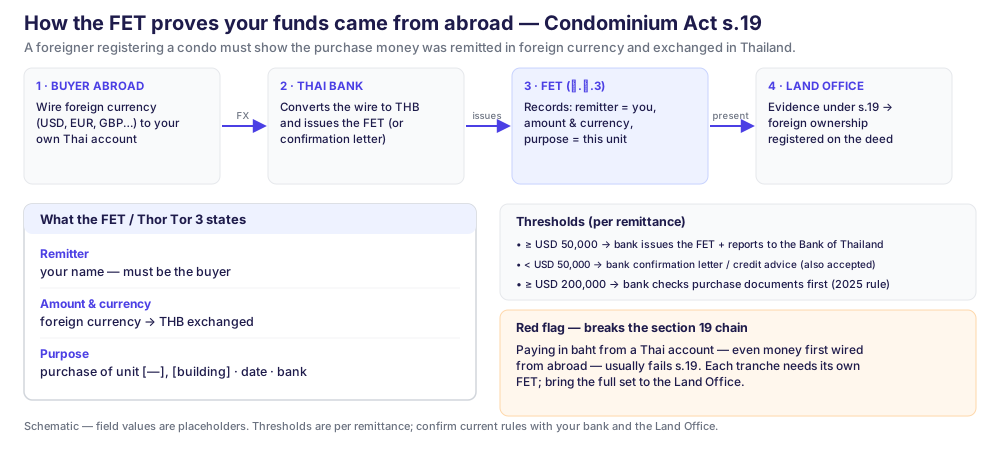
The Foreign Exchange Transaction Form (FET), formerly known as the Thor Tor 3 form, is a document a Thai bank issues to record foreign currency remitted into Thailand and exchanged into baht. It names the remitter, states the amount and currency exchanged, and records the stated purpose of the funds.
For a condo purchase, the FET should name the buyer as the remitter and state the purpose as the purchase of the specific condominium unit. This ties the incoming money to the transaction and provides the evidentiary link the Land Department requires.
Confirm the Condominium Act s.19 evidence requirement
Section 19 of the Thai Condominium Act conditions a foreigner's right to own a condo unit on the purchase funds being remitted from abroad in foreign currency. The Land Department requires evidence of that remittance before it will register the foreign buyer's name on the title deed.
The FET form — or the bank's equivalent confirmation letter for smaller amounts — is that evidence. A purchase funded by a Thai baht transfer from within Thailand, even from an account that was originally funded by an overseas wire, typically does not satisfy section 19 and can result in the Land Department refusing to register the foreign ownership.
Apply the USD 50,000 threshold
For an inward remittance of USD 50,000 or more (or its equivalent in another foreign currency), the receiving Thai bank is required to prepare and issue the FET form and report the transaction to the Bank of Thailand. The bank issues the FET automatically once the amount reaches the threshold.
For amounts below USD 50,000, the bank does not issue the formal FET form but will provide a credit advice note, confirmation letter, or equivalent document recording the foreign-currency transfer and exchange. Either document serves the evidentiary purpose at the Land Office; which one you receive depends solely on the amount of each remittance.
Expect documentary checks on large remittances
Since 29 December 2025, a Bank of Thailand rule requires Thai banks to verify supporting documents for any inward foreign-currency transaction of USD 200,000 or more whose stated purpose is investment in Thai real estate, rather than relying on a simplified customer profile. For a condo purchase at or above that amount, expect the bank to ask for the sale and purchase agreement, the reservation agreement, or other proof of purpose before it processes the transfer and issues the FET.
This is separate from the USD 50,000 FET-issuance threshold and does not change who needs a FET — it means the paperwork is checked more closely at the higher amount. Prepare the purchase documents in advance and make sure the stated purpose on the wire matches them, so a large transfer is not held up.
Handle multi-tranche remittances
If the total purchase price requires several transfers — for example a deposit, staged instalments, and a final balance — each remittance generates its own FET form or bank confirmation letter. Keep the original of every document in the set.
At the Land Office you will need to produce the full set covering the entire purchase price. A gap in the documentation — for example because one tranche was sent as a baht transfer rather than a foreign-currency remittance — can prevent or delay registration. If you are unsure whether a past transfer was recorded correctly, ask the bank for a certified record before transfer day.
Understand the link to the 49% foreign-ownership quota
The FET requirement and the foreign-ownership quota are separate conditions, but both must be satisfied for a foreigner to register condo ownership. The foreign quota — a maximum of 49% of the floor area of all units in the building, held by non-Thai nationals under the Condominium Act (section 19 bis) — limits how many units in a building can be foreign-owned at all. The FET proves the funds arrived correctly for units that are within quota.
If the project's foreign quota is already exhausted, producing a perfect FET does not cure the quota problem — the Land Department will still refuse registration. Confirm the quota position with the developer and ensure the SPA includes a remedy clause before committing funds.
Get the FET right at your bank
Remit the funds in a recognized foreign currency — such as USD, EUR, GBP, SGD, AUD, HKD, or JPY — by international wire transfer to a Thai bank account in your name. When the bank processes the inward transfer, instruct them to record the purpose as the purchase of the specific condo unit and to name you as the remitter.
Keep the original FET form or bank confirmation letter. If you lose the original, ask the bank whether it can issue a certified replacement — practices vary by bank and branch. The Land Office in some provinces accepts certified copies; confirm locally before transfer day.
Spot red flags that risk refused registration
Transferring baht from a Thai account rather than remitting foreign currency from abroad is the most common mistake that causes Land Department refusal for foreign buyers. Even if the baht in that account originated from an overseas wire, if the exchange happened outside Thailand the evidentiary chain under section 19 is broken.
A FET that names someone other than the buyer as remitter, or that states a purpose other than the condominium purchase, may not be accepted. A FET with the wrong unit number or a different purchase price than the SPA also creates risk — verify all details match the SPA and the title deed before transfer day.
A developer or agent who suggests routing funds through a Thai nominee to avoid the FET requirement, or who says the FET is not needed for your transaction, is giving advice that conflicts with the Condominium Act and standard Land Department requirements. Verify requirements with the Land Office directly or through a Thai lawyer.
Frequently asked questions
- What is the FET form for a condo purchase?
- It is the bank document recording foreign currency remitted into Thailand and exchanged into baht for the purchase. The Land Department requires it as evidence of overseas funds to register a foreigner's condo ownership under section 19 of the Condominium Act.
- When does the bank issue a FET form versus a confirmation letter?
- For a remittance of USD 50,000 or more the bank issues the FET form and reports the transaction to the Bank of Thailand. For amounts below USD 50,000 the bank issues a credit advice, confirmation letter, or equivalent note instead. Both serve the same evidentiary purpose at the Land Office. Separately, for transfers of USD 200,000 or more for a property purchase, a 2025 Bank of Thailand rule requires the bank to verify your purchase documents before processing.
- Can I pay from a Thai baht account instead of remitting from abroad?
- Not for registering foreign ownership. The funds must arrive from abroad as foreign currency and be converted in Thailand. A baht-only transfer from a Thai account — even one originally funded by an overseas wire — typically does not satisfy section 19 of the Condominium Act and can result in the Land Department refusing registration.
- What if I remit the purchase price in multiple transfers?
- Each remittance generates its own FET form or bank confirmation letter. Keep all originals. You will need the full set at the Land Office to evidence that the entire purchase price was remitted from abroad in foreign currency. A gap in the set — one transfer made in baht or missing from documentation — can block registration.
- Does the FET requirement link to the 49% foreign-ownership quota?
- They are separate conditions. The quota — a maximum of 49% of the floor area of all units foreign-owned in any building — determines whether a foreigner can own the unit at all. The FET proves the funds arrived correctly for that unit. Both must be satisfied. A correct FET does not override a quota that is already exhausted.
- What purpose should the FET state?
- The FET should state the purpose as the purchase of the specific condominium unit, ideally referencing the unit number and building. This ties the incoming funds to the transaction. A FET that states a vague or unrelated purpose may not be accepted by the Land Department as sufficient evidence under section 19.